Mystic Prophecy: “I’m Now 60 and I’m on Fire”, Roberto Dimitri Liapakis Is Still in Metal.
Interview by Paul Marshall
Write Said Paul catches up with Mystic Prophecy frontman Roberto Dimitri Liapakis to talk about 26 years of heavy metal, the band’s forthcoming album In Metal, artificial intelligence, working with Michael Schenker, and the possibility of bringing some German metal firepower to New Zealand.
It’s just gone 12:30 am in New Zealand when I finally get the pleasure of talking to the frontman of German heavy metal outfit Mystic Prophecy, the one and only Roberto Dimitri Liapakis, or simply Lia, as he prefers to be called.
It’s an unreasonable hour to be conducting an interview in New Zealand, but not so for Lia over in Germany. Such is the life of a music journalist: if you want to talk to European rock stars, you need to put in the hours, and its no problem for me.
Thankfully, Lia is full of life, enthusiasm and the kind of energy that makes the late-night effort worthwhile. I kick things off by telling him I have some interesting questions lined up and, hopefully, nothing too boring. His response comes back without hesitation.
“Nothing is boring man”
And just like that, I know we’re going to have a great conversation.
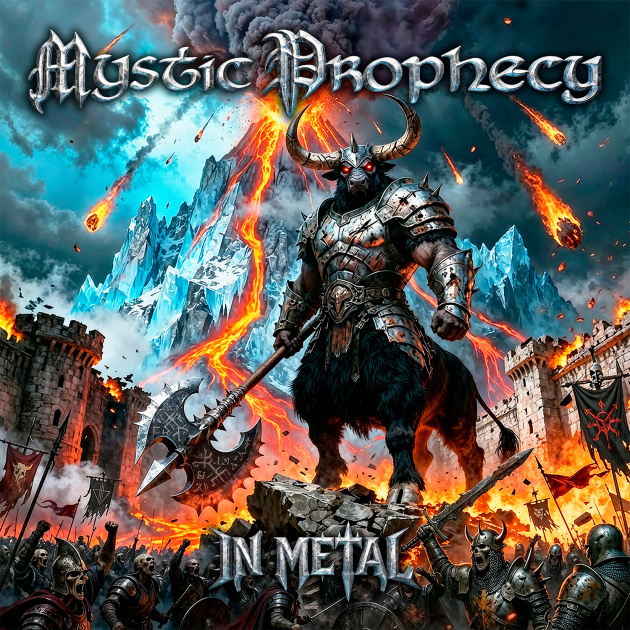
Mystic Prophecy are preparing to unleash their highly anticipated new album, In Metal, due out on November 27. After more than a quarter of a century flying the heavy metal flag, Lia and his bandmates show little sign of slowing down. If anything, there’s a renewed sense of purpose behind the new record, and as our conversation unfolds, it becomes clear that metal is far more than a musical genre to Lia. It’s a community, a way of life and something he has no intention of walking away from anytime soon.
“YOU ARE IN METAL, I’M IN METAL”
I start by asking Lia about the album’s title. In Metal is a pretty uncompromising statement, so what does being “in metal” actually mean to him?
“In Metal is all of our heavy metal community, you are in metal, i’m in metal and all our loyal fans are in metal”
He continues, underlining just how much the band’s audience means to him.
“we are really really proud to have over 26 years of loyal fans and without loyal fans you cannot exist, so big thanks about that”.
There’s no mistaking the sincerity in his answer. In an industry where trends come and go, and where bands can disappear almost as quickly as they arrive, maintaining a loyal fanbase for 26 years is no small achievement. Mystic Prophecy have clearly built something that extends beyond a collection of albums and concert appearances. There’s a bond between the band and its fans that Lia is genuinely proud of.
I congratulate him on the longevity of the band, because staying relevant for that long takes more than simply plugging in the guitars and turning the amplifiers up to eleven.
So, what’s the secret?
“every eighteen months we are releasing an album, on this one I took a little bit more time, so you have to top other great albums”
It’s an approach that speaks volumes about his work ethic. Mystic Prophecy have consistently delivered new music, but Lia understands that longevity also means maintaining standards. With albums such as Satanic Curses (2007), War Brigade (2016) and Metal Division (2020) forming part of the band’s back catalogue, In Metal has some formidable competition to contend with.
The challenge isn’t simply to release another album. It’s to make one that stands proudly alongside everything that came before it.
SIX DECADES OF LIFE, A LIFETIME OF METAL
Heavy metal has always been a genre that rewards conviction. You either believe in it or you don’t, and Lia’s enthusiasm suggests there’s very little chance of him losing the faith.
I ask whether his definition of heavy metal has changed as he’s got older, or whether he has simply become more certain about what it should be.
His answer is emphatic.
“No, no, no I started hearing heavy metal music when I was 6, I'm now 60 and I'm on fire, more than I was younger”
That’s the spirit. While plenty of people spend their later years slowing down, Lia sounds like someone who has barely taken his foot off the accelerator. He credits music with keeping him energised, and judging by his appearance and the enthusiasm he brings to our conversation, it’s hard to argue with him.
There’s something refreshing about speaking to a musician who has spent decades in the business yet still sounds genuinely excited about what he does. For Lia, heavy metal isn’t a nostalgic attachment to his youth. It’s very much a living, breathing passion.
And if In Metal is anything to go by, he has no intention of letting that fire burn out.
ROBOTS, AI AND THE FUTURE OF CREATIVITY
The new album opens with “Robots,” a track that raises questions about technology and how much control humanity is willing to surrender to it. It’s a particularly relevant subject in an age when artificial intelligence is rapidly changing the creative industries.
I ask Lia whether he sees modern technology as a threat to human creativity or whether musicians can use it to their advantage.
“we have to take care and take the control, not give the control to the robots or the AI, we have to tell AI what to do”
It’s a straightforward answer, but an important one. Technology can be a powerful tool, yet there’s a difference between using it to realise a creative vision and allowing it to dictate that vision in the first place.
That brings me to “March or Die,” one of the band’s recent singles, which features an AI-generated music video. It’s an interesting choice for a band whose identity is so deeply rooted in the raw, human power of heavy metal.
So, why use AI for the video rather than go down the traditional production route?
“If you check out the video, you’ll see every word I say, is fixed with a scene on the video, so its not easy to make a video like this, there is a story behind the words”.
Lia makes a fair point. Creating a compelling music video still requires a concept, a story and a clear understanding of how the visuals should complement the music. Even when AI is involved, someone has to guide the technology, generate the appropriate imagery, select the right sequences and edit everything together so the finished product works in time with the song.
It’s not simply a case of pressing a button and watching a video magically appear.
In many ways, we’re witnessing the early stages of a new creative relationship between human beings and machines. AI is opening doors that might previously have been inaccessible to artists working with limited budgets, but it also raises questions about authorship, originality and where the human element fits into the process.
For Mystic Prophecy, the interesting question isn’t necessarily whether AI belongs in music. It’s how musicians choose to use it without losing control of their artistic identity.
And judging by Lia’s comments, he’s firmly in the camp that believes the technology should serve the artist, not the other way around.
240 BPM AND NO SHORTCUTS
From robots and artificial intelligence, we turn to something considerably more physical: the sheer speed and intensity of Mystic Prophecy’s music.
“Angels Are Falling” reaches a blistering 240 beats per minute, which is enough to leave plenty of musicians struggling to keep up. I ask Lia what makes him want to push a song to those kinds of physical limits, and how the band manages to reproduce that intensity on stage.
His answer highlights an important aspect of the Mystic Prophecy philosophy.
“I have a young boy on the drums and he’s really really good and fast on his feet, I think some people think that Mystic Prophecy songs are easy to play but they are not easy, we never record a song we cant play live”.
That final point says a lot about the band. It’s one thing to create an impressive recording in the studio, where multiple takes and production techniques can help shape the final result. It’s quite another to deliver the same material night after night in front of a live audience.
At 240 BPM, there’s precious little room for error. The drummer needs exceptional stamina and precision, the guitars have to remain locked in, and the vocals need to cut through the relentless assault without losing their character.
Lia clearly takes pride in the fact that Mystic Prophecy don’t record music they can’t reproduce on stage. For a heavy metal band, that commitment to live performance matters. The studio is where the songs take shape, but the stage is where they have to prove themselves.
And with a frontman who insists he’s more on fire at 60 than he was when he was younger, I suspect the band’s live shows are unlikely to be short on intensity.
FROM SOLDIER TO SHARING THE STAGE WITH MICHAEL SCHENKER
One of the more remarkable chapters in Lia’s career has seen him working alongside legendary guitarist Michael Schenker, best known for his work with UFO and his influential place in the history of hard rock.
For any vocalist who grew up listening to classic rock, performing this material alongside the guitarist responsible for so many iconic riffs must be a special experience.
I ask Lia whether it was a childhood dream come true.
His answer takes us back to 1984.
“Oh man 1984 I was a soldier and I hear Rock Will Never Die album the live one, and after forty years I'm on the stage with him and playing these songs with UFO, he liked the raspy tone in my voice and the bluesy rock so I got the job”.
It’s quite a story. One moment, Lia is a young soldier listening to Michael Schenker’s live work; four decades later, he’s standing on stage performing the songs that helped shape his musical world.
Sometimes, the music business delivers opportunities that are difficult to imagine when you’re first starting out, and this is certainly one of them.
Lia initially stepped in as a temporary replacement vocalist for Schenker during the European leg of the My Years With UFO 50th-anniversary tour in 2025. He covered for Erik Grönwall during shows in Madrid and Barcelona when Grönwall had to return to Sweden for family reasons.
What began as a fill-in opportunity subsequently developed into further live performances and US tour dates celebrating the UFO years, alongside additional festival appearances.
For Lia, the connection seems to have been a natural fit. Schenker recognised something in his raspy vocal tone and blues-rock sensibility, and the opportunity allowed him to revisit music that had been part of his own journey for decades.
There’s a certain symmetry to it all: a lifelong metal fan gets to stand beside one of his heroes and help bring those classic songs to a new generation of audiences.
Not a bad way to spend a career.
THREE ALBUMS FOR A DESERT ISLAND
Every musician has their influences, and I’m always interested in discovering what artists return to when they’re not busy creating their own music.
So I throw Lia the classic desert-island question: if he could take only three albums with him, which records would make the cut?
His first choice is no surprise to anyone familiar with his appreciation for great vocalists.
“the first one is from Bad Company, as Paul Rodgers is my favourite vocalist, then I think I will take Mercyful Fate, their first album”
He’s referring to Melissa, the landmark 1983 debut from Danish heavy metal pioneers Mercyful Fate, a record renowned for its dark atmosphere, intricate guitar work and King Diamond’s distinctive vocals.
Lia’s third choice brings us firmly into the territory of classic British heavy metal.
“Then from the heavy part its The Number of the Beast by Iron Maiden”.
It’s a strong selection. Bad Company represents the blues-driven hard rock tradition and the extraordinary voice of Paul Rodgers. Mercyful Fate brings the darker, more theatrical side of heavy metal, while Iron Maiden’s The Number of the Beast stands as one of the defining records of the New Wave of British Heavy Metal.
Taken together, the choices offer a glimpse into the musical DNA behind Lia’s own approach. There’s melody, power, atmosphere and a healthy appreciation for the artists who helped establish the foundations of the music he continues to play today.
It also reinforces a point that comes through repeatedly during our conversation: heavy metal might evolve, but its roots remain important.
WILL MYSTIC PROPHECY EVER PLAY NEW ZEALAND?
With the conversation drawing towards its conclusion, I have one final question, and it’s a big one for those of us down here at the bottom of the world.
Are there any plans to bring Mystic Prophecy to New Zealand?
For a band with such a long history and a sound tailor-made for a live setting, it would be great to see them perform here. But as Lia explains, getting a European band to the other side of the world isn’t always straightforward.
“we would love to come to New Zealand but its very expensive and a long way, however if someone calls me and says they will pay for the flights and hotels them ill be there”
He isn’t finished there, though.
“No really man if someone calls me and wants me to play there, then I'm there”
Well, New Zealand promoters, you’ve heard the man.
If you’re looking to bring a serious dose of German heavy metal to local audiences, Lia sounds more than willing to make the trip happen. The challenge, as ever, is getting the logistics and finances to stack up. International touring is expensive, and New Zealand’s distance from Europe makes it a particularly significant undertaking.
But the enthusiasm is there, and sometimes that’s the first step towards turning an idea into a show.
If you’d like to see Mystic Prophecy perform in New Zealand, get in touch with Lia or contact me at Write Said Paul, and let’s see if we can make it happen.
STILL IN METAL, AND STILL ON FIRE
By the time we wrap things up, it’s only minuets to 1 am in New Zealand, and I’m more than ready to call it a night. Lia, meanwhile, has brought the kind of enthusiasm to the conversation that makes you understand why he’s still doing this after 26 years.
From the forthcoming In Metal to the challenges of incorporating AI into music videos, from playing at 240 BPM to sharing a stage with Michael Schenker, our conversation has covered a lot of ground.
What stands out most is Lia’s genuine passion for what he does. There’s no sense of someone simply going through the motions or resting on past achievements. He’s still creating, still pushing himself, still looking for ways to take the music forward, and still appreciative of the fans who have supported Mystic Prophecy along the way.
At 60, he insists he’s more fired up than ever. After speaking to him, I have little reason to doubt it.
In Metal arrives on November 27, and if Lia’s enthusiasm is anything to go by, Mystic Prophecy are ready to remind everyone exactly what that title means.
Because for Lia, metal isn’t just something you listen to.
It’s something you live.
And after 26 years, he’s still very much in it.
Mystic Prophecy – In Metal Track Listing:
- Robots (03:27)
- In Metal (03:30)
- March or Die (03:55)
- Don't Run Away (04:00)
- Warhead (03:42)
- Angels Are Falling (04:34)
- When the Hammer Will Fall (03:12)
- My Inner Innocence (04:05)
- Devil's Son (03:50)
- Warrior of Asgard (03:46)