Enslaved’s Iver Sandøy: Finding the Centre, Embracing the Chaos and Why Friendship Comes First.
Interview by Paul Marshall
I’ve always maintained that the drummer is the coolest person in any band. Why? Because drummers are the backbone, the engine room and, quite often, the unsung heroes holding the whole operation together. Today, I’ve had the pleasure of putting that theory to the test with a phenomenal drummer and band member of Norwegian progressive metal heavyweights Enslaved, Iver Sandøy.
And what a name for a metal band! Enslaved. Given the way the music industry can consume your life, there’s a certain irony in the name. If you’re going to be a slave to something, though, music probably isn’t the worst master to have.
Sandøy is a fascinating character to talk to, and our conversation gets off to a rather unexpected start. Like any seasoned rock star, he’s been moving from one interview to the next, so I begin by telling him I’m calling from Auckland, New Zealand.
“Wonderful. You know, I've recently been working with a countryman of yours, the great Chris Thompson,” he tells me.
Yes, that Chris Thompson, best known for his work with Manfred Mann’s Earth Band.
“He's been recording in my studio for quite a few years now,” Sandøy continues. “He's working on what he claims is his last album, but we'll see. He's pretty energetic.”
And there you have it. You never quite know where a music interview is going to take you, and before we’ve even started talking about Enslaved, we’re already connecting Norwegian metal with one of the great voices of classic rock.
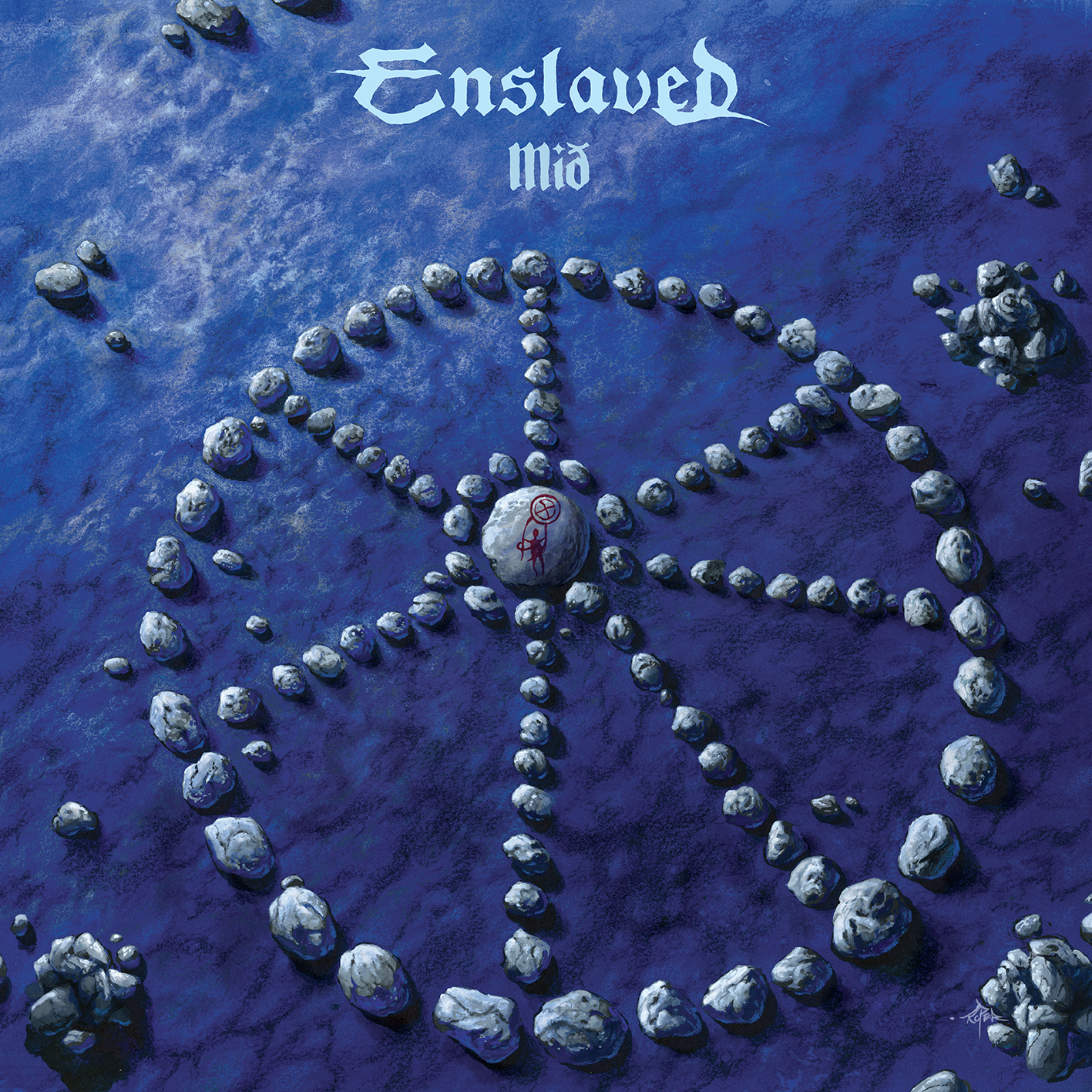
But it’s Enslaved’s own music that brings us together today, with the band preparing to release their seventeenth studio album, Mið, on 30 October 2026.
The title translates from Old Norse as “the centre” or “the middle”, which seems an intriguing concept for a band whose music has spent decades exploring the boundaries between extreme metal, progressive rock, ancient mythology and atmospheric soundscapes.
I ask Sandøy whether finding that centre is something he feels the band have achieved with this record.
“The thing about the recording process for this album was that we ended up, through various variables, having a very concentrated time to both write and record the album,” he explains. “Long story short, we ended up having the month of April, so just a month, more or less, to get it all done. So we had a knife hanging over our heads. Did we find our centre? Yeah, I think we succeeded in finding that balance in ourselves.”
It sounds less like a carefully orchestrated recording schedule and more like a creative deadline designed to test everyone involved.
Sandøy believes that pressure ultimately helped shape the album.
“The album perhaps comes across as a little bit more stripped back than the previous albums. There's less layering and instrumental overdubs. There's a little bit less of that, and the elements that are there are more to the point. So in that way, yes, I feel we can defend the album title, and what came out the other end, after all that stress and pressure, actually feels quite centred.”
There’s something appealing about that approach. In an era when recording technology allows artists to endlessly tweak, layer and polish every last detail, sometimes the best thing you can do is put yourself under pressure, trust your instincts and get on with it.
Of course, that’s easier said than done when you’re making a record with most of the songs still incomplete.
I ask Sandøy whether Enslaved would normally have written and road-tested their material before entering the studio.
“Normally we have more or less a full album written when we enter the studio, so that was very different this time,” he says. “I think we just chose to embrace it because, firstly, we've been doing this a long time. This was album number 17, so why not change things up a little bit, to not feel that you're just doing the same over and over?”
Seventeen albums. That’s a serious body of work by anyone’s standards, and the willingness to throw the established process out the window says plenty about a band that clearly has no interest in simply repeating its past.
I suggest that one advantage of making an album quickly is that you don’t have to listen to the songs a thousand times through different recording and mixing stages, potentially becoming sick of them before you’ve even had the chance to perform them live.
Sandøy agrees, and I can’t help thinking there’s a lesson in that for musicians everywhere. Sometimes, less really is more. Not because you should compromise on quality, but because there comes a point when you need to stop analysing the music and let it breathe.
Having spent time with Mið, I tell Sandøy that one of my favourite tracks is “Parting”.
“Cool. Yeah, I got to flex my Bonham muscles a bit, not only on that one, but there are several,” he says.
For those who might need a little musical translation, we’re talking about John Bonham, the legendary Led Zeppelin drummer whose thunderous playing remains a benchmark for generations of percussionists.
“That was written by Ivar, and we've known each other for 25 years. He is well aware of me being the Bonham guy. I guess I was that guy for him way before he even considered bringing me into the band. Because with my other band, it was more… let's say that the Zeppelin influence was a bit more obvious.”
There’s a lovely little insight here into the relationship between Sandøy and Enslaved’s Ivar Bjørnson. When you’ve known someone for a quarter of a century, you develop an understanding that goes beyond simply knowing their musical abilities. You know their instincts, their influences and exactly which buttons to press when you want them to bring something special to a song.
And if you’re a drummer who gets the opportunity to flex your inner Bonham, you’d better believe you’re going to take it.
Friendship, chemistry and the long road.
One of the things that has always interested me about bands with genuinely long careers is what keeps the wheels turning when the initial excitement of making music together has long since become a lifetime commitment.
Enslaved have evolved considerably over the years, but the relationships between the people involved have helped them navigate those changes.
I ask Sandøy how much of the band's longevity comes from the fact that the members knew one another before they started playing together.
“Ivar and Grutle have known each other since their teenage years, and the rest of us have entered the picture at various stages,” he explains. “I think the friendship has always come first. And then it's been a case of, with every member of Enslaved, it's been like that. Like, ‘Oh, we need a keyboard player. How about you be the keyboard player?’ over a beer. And it's kind of evolved organically like that.”
And perhaps that tells us more about Enslaved than any description of their musical influences ever could.
These are people who have grown together, developed their craft and built something that has survived changes in personnel, musical direction and the demands of a notoriously difficult industry.
As someone who has spent decades around touring musicians, I know that being a great musician is only one part of the equation. You can be the most technically gifted player in the world, but if nobody wants to spend time with you, you’ve got a problem.
You’re sharing vans, planes, dressing rooms, hotel rooms and tour buses. You’re spending weeks or months in close quarters, often under considerable pressure, and then you’re expected to walk onstage together and create something extraordinary night after night.
I put that to Sandøy, and he’s quick to agree.
“You're so right. I think a lot of people, maybe even people in bands that haven't travelled much, miss out on the fact that it really isn't about who is the brilliant musician as much. It's the chemistry. Can you stand being on the bus with this guy for three weeks, or a month, or two months? And if not, it's just…”
He trails off, but the point has already landed.
It’s a truth that applies well beyond music. Talent might get you through the door, but relationships are often what keep you there. In Enslaved’s case, that sense of friendship and organic development appears to have given the band a solid foundation from which to take creative risks without losing their collective identity.
Looking to the sun, the sea and something greater
While “Parting” gave Sandøy the opportunity to unleash his inner Bonham, another track that caught my attention was the single “Solar Will”.
The song introduces listeners to themes of solar symbolism, ancient beliefs and the forces that shape human consciousness. It’s territory that feels particularly appropriate for Enslaved, a band whose music has long drawn on Norse history, mythology and the relationship between humanity and the natural world.
I ask Sandøy whether he thinks people today are searching for the same sense of meaning that ancient cultures sought through their myths.
“Ah, that's a big one,” he says, before considering the question. “We probably are. Because we're still people, aren't we? So there must be parallels to those ancient beliefs in our modern world. I mean, we still depend on the sun, so that hasn't changed.”
It’s a deceptively simple observation. We might live in a world of smartphones, artificial intelligence and instant communication, but the fundamentals of human existence haven’t changed quite as much as we sometimes imagine.
“We, through the '70s, '80s, '90s, the human, or at least the Western mentality, went through an era of distancing ourselves from nature,” he continues. “Because it's becoming more evident that we are not separate from nature, and because it's catching up with us.”
Sandøy believes that realisation could lead to an even greater search for symbolism and meaning in the natural world.
“I think there will be more, probably even more, search for symbolism or relating to forces like the sun or the ocean, which is a big factor where I grew up, on a tiny island on the west coast of Norway.”
And this is where the conversation takes a more personal turn.
Sandøy explains that his ancestors had been fishermen for hundreds, and probably thousands, of years, living on a small plot of land where they might raise a sheep or, in the best circumstances, a cow.
“The ocean is your constant provider, but also a terror,” he says, reflecting on generations of family members who went out fishing and never returned.
“The sun being the sun and the ocean being givers of life, but also the terror of it can also be a terrible master.”
It’s a powerful image, and one that adds another dimension to the themes running through Enslaved’s music.
For a community dependent on the sea, nature is never simply a pretty backdrop. It is sustenance, livelihood, danger and the force that ultimately determines whether you make it home. The same ocean that provides life can take it away, while the sun that sustains the world becomes a reminder of humanity’s dependence on forces far beyond its control.
Listening to Sandøy describe the environment in which his family lived, it becomes easier to understand why ancient symbolism and humanity’s relationship with nature continue to resonate with him. These aren’t necessarily abstract ideas pulled from history books. They are connected to a landscape, a heritage and the lived experiences of generations.
And perhaps that’s part of the appeal of Enslaved. Beneath the weight of the guitars and the complexity of the arrangements, there is an ongoing fascination with who we are, where we come from and how we fit into a world that existed long before us.
Will Enslaved finally make it to New Zealand?
Of course, no conversation with an international band would be complete without asking the question every New Zealand music fan wants answered.
With Enslaved preparing to unleash Mið, I ask Sandøy whether there are any plans to bring the band to our shores.
“Oh, that is still an area on the world map that we have not been able to tick off,” he says. “It would have been lovely to be able to tick that off. So, if a combined Australian-New Zealand tour would be interesting enough for us to endure the travel and for the cost…”
And there it is, a glimmer of hope for Kiwi fans.
New Zealand’s geographical isolation has always presented challenges for international touring artists. The distance, the expense and the logistics can make a standalone visit difficult to justify, particularly for bands working outside the commercial mainstream. A combined Australian and New Zealand run, however, could be the answer.
For now, it remains a possibility rather than a confirmed plan, but at least the desire to tick New Zealand off the list is there.
We wrap up our conversation with a friendly exchange of goodbyes, and Sandøy leaves me with one final compliment.
“Great conversation. Thank you.”
Likewise, Iver. It’s always a pleasure to speak with a musician who can discuss the intricacies of recording a progressive metal album one minute and the importance of friendship, family history and humanity’s relationship with nature the next.
Until Enslaved finally make their way to New Zealand, we’ll have to settle for experiencing the band through their music. Fortunately, we won’t have long to wait.
Enslaved’s seventeenth studio album, Mið, arrives on 30 October 2026. Born out of a month of intense writing and recording, it finds a veteran band embracing uncertainty, stripping back its arrangements and trusting the chemistry that has carried it through decades of creative evolution.
And if “Parting” is anything to go by, Sandøy still has plenty of Bonham-inspired thunder left in the tank.
Enslaved – Mið. Out 30 October 2026.