
Live at Spark Arena
25 September 2026
Live Review by Music Journalist: Paul Marshall
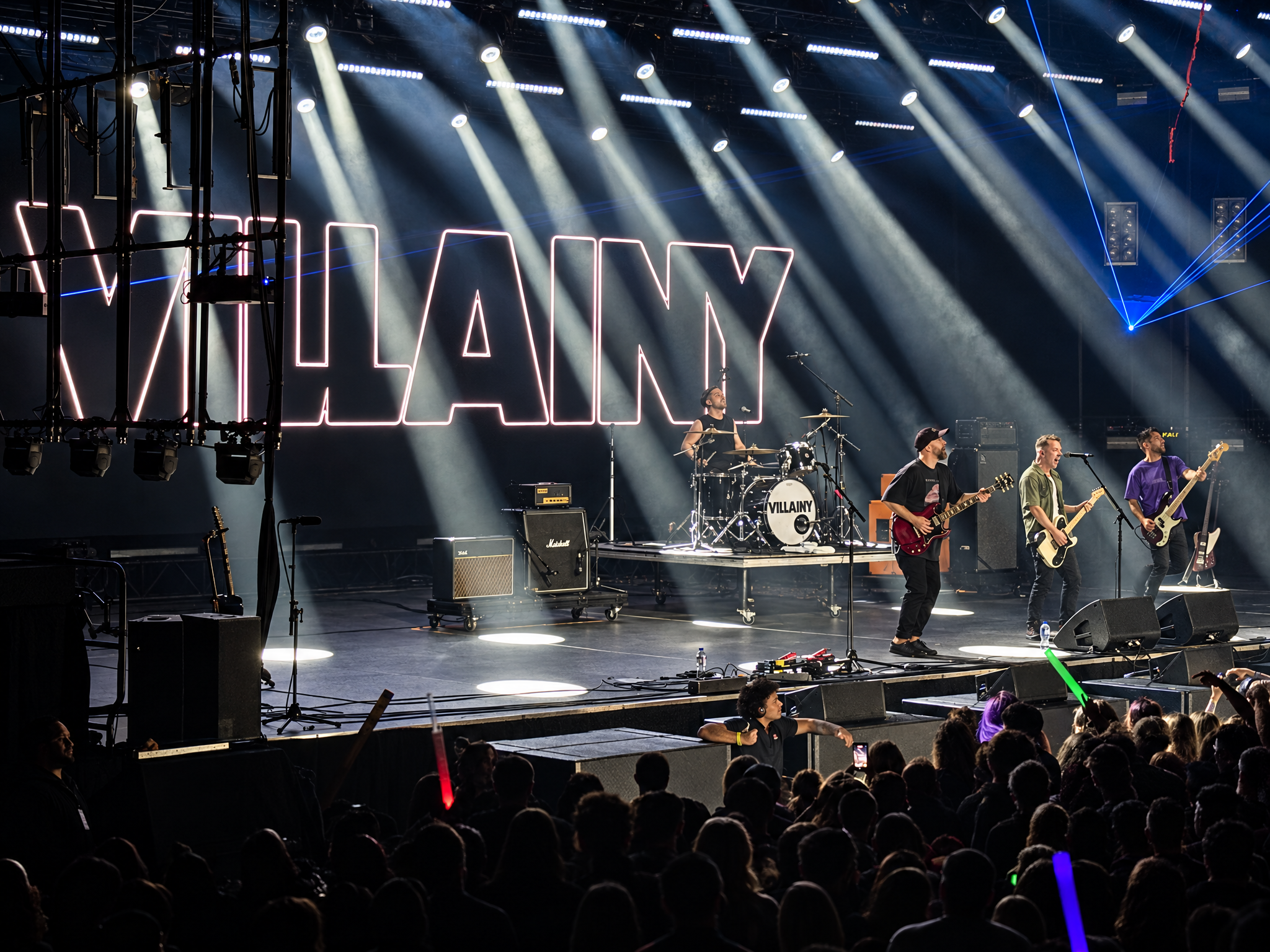
Villainy deliver the rock, but leave some arena magic on the table.
There was something wonderfully appropriate about walking into Spark Arena and finding the place packed with sparkies, builders, tradies and the wider tribe of New Zealand rock fans. This was never going to be a room full of people worried about whether their shoes matched their shirt. This was a rock show and Auckland had turned up ready for some noise.
And then came the introduction.
The DJ made the big announcement: “Villainy!”
Nothing.
Silence.
No band.
No immediate explosion of guitars.
Just a rather awkward stretch of empty stage following a big announcement that promised something was about to happen.
After roughly 30 seconds, an introductory track finally began to roll, and then, from stage right, the four members of Villainy appeared and got on with the job.
It was an interesting reminder of just how important those first few seconds of a live performance can be. There is a reason many international touring agreements contain very specific protocols around who introduces an artist, because the entrance is part of the show. You build anticipation, you create tension, and then you release it.
Here, the tension simply sat there for a little too long.
Once the music started, however, Villainy were off.
The Auckland four-piece, Neill Fraser on vocals and guitar, Dave Johnston on drums, James Dylan on bass and Thomas Watts on guitar, are hardly newcomers who need an introduction. Formed around 2010, they have spent more than a decade establishing themselves as one of Aotearoa's better-known rock exports. Their debut Mode. Set. Clear. arrived in 2012, followed by Dead Sight in 2015 and Raised in the Dark in 2019. The latter reached No. 2 on the New Zealand Albums Chart, while the band have collected three Aotearoa Music Awards for their rock work.
They've also done the hard yards live, sharing stages with the likes of AC/DC, Incubus, The Offspring, Billy Talent and Halestorm, as well as appearing at major New Zealand festivals.
So expectations were reasonably high.
The first thing that struck me was that Villainy didn't exactly look like a band arriving to conquer one of Auckland's biggest indoor stages.
There was very little visual identity.
In fact, they looked a little like four guys who had just finished a shift at a local factory, been told there was a gig at Spark Arena, and hadn't quite had time to get home and change.
Now, there is absolutely nothing wrong with looking like ordinary blokes. Rock music has never demanded that everyone dress like a Las Vegas revue. But when you're playing a major arena, the visual presentation is part of the performance. The audience isn't just listening, they're looking.
And Villainy didn't appear to be giving the visual side of the show the same attention they were giving the music.
Then, only two songs in, another distraction arrived.
A technician was on stage trying to sort out Neill Fraser's guitar wireless system while Fraser continued moving around somewhat. From where I was standing, the poor tech wasn't exactly being given an easy life.
It was one of those moments when you realise just how many things have to go right behind the scenes for a band to appear effortless.
The irony was that the audience could see the effort.
What surprised me more was hearing backing tracks being used during the set.
This became particularly obvious when the giant screen behind the band showed all four members apparently singing together in harmony, while on the actual stage, the members weren't even attempting to get anywhere near their microphones at that particular moment.
That creates a strange disconnect.
If the audience can see four musicians apparently singing live on the giant screen, but the four people standing in front of us aren't actually singing those parts, the illusion becomes rather obvious.
And once you notice it, you can't really un-notice it.
But here's the thing about Villainy: despite all of those observations, I still enjoyed the set.
Because underneath the production quirks and presentation issues, there are some bloody good songs.
This is a band that knows how to write a big rock hook. Fraser has a distinctive voice, and while it sounded strong early in the set, I felt that his vocals became increasingly worn as the performance progressed. The voice that initially caught my attention began to lose some of its strength as the set developed.
Yet when Villainy's songs hit, they hit.
There is a reason this band has survived more than a decade in an industry where plenty of promising rock bands disappear after an album or two. They've built a catalogue, developed an audience and repeatedly demonstrated that they can stand on stages alongside some very big international names.
Earlier in 2026 they were back out there again, including a Homegrown appearance and Auckland shows, while their new single “Happy Waste” arrived in April as the first taste of their forthcoming fourth studio album. The band's own biography describes the new material as the next chapter following three studio albums and more than a decade of live work.
And that history matters.
Because Villainy aren't some inexperienced support act trying to work out how to fill a stage.
They've done this.
They've played major festivals. They've toured. They've supported international heavyweights. They've headlined venues. They've spent years learning the craft of being a live band.
Which is why, on this particular evening, I found myself wondering what Villainy might have delivered with a little more attention paid to the theatre of the performance.
The songs were there.
The musicianship was there.
The experience was there.
But the presentation didn't always match it.
The opening announcement needed to explode rather than deflate. The wardrobe could have suggested a little more occasion. The technical issue could have been handled with more cooperation between performer and crew. And the use of backing tracks needed to be more carefully integrated into what the audience was actually seeing.
None of that takes away from the fact that there were moments when Villainy sounded exactly like the band their reputation suggests they should be.
And perhaps that's the frustrating part.
There is a bigger, more commanding arena show hiding inside this band.
Villainy have already proved they can write the songs and fill the room with sound. Now they need to make sure every other element of the performance is working as hard as the music.
Because when the lights, visuals, musicians, vocals and production all line up, a good rock band becomes something considerably more memorable.
For this particular Spark Arena appearance, Villainy gave us the songs.
I just wanted a little more Villainy the spectacle.
Reviewer: Paul Marshall
Photography by Paul Marshall
WATCH THE LIVE VIDEO at Paul Was There -