OBSCURA: The Long Game
An Interview with Steffen Kummerer
Interview by Paul Marshall
There are musicians who join bands, musicians who front them, and then there are the rare few who become the engine room, the people who refuse to stand still, who keep pushing the creative boundaries and dragging the band forward with them.
Steffen Kummerer is very much the latter.
Founder, guitarist, vocalist, mastermind and driving force behind German technical death metal giants OBSCURA, Kummerer has spent almost 25 years building a band that has never been content to simply repeat itself. Now seven albums into their career, OBSCURA aren't showing any signs of slowing down. If anything, they appear to be becoming more ambitious and increasingly popular, with every passing year.
Tonight, I’m talking with none other than Steffen Kummerer, a man after my own heart: fiercely driven, creatively uncompromising and clearly not interested in taking prisoners.
I don't waste any time. We get straight into it.
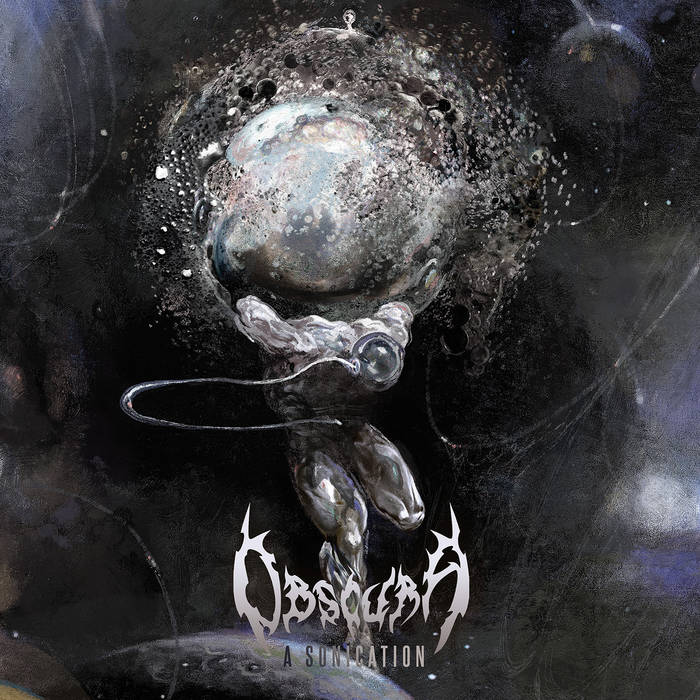
OBSCURA's latest album, A Sonication, finds the band walking an intriguing line between breathtaking technicality and something considerably more emotionally immediate. The musicianship remains extraordinary, but there is a sense that the songs themselves are becoming increasingly important.
So I ask Steffen whether that accessibility was something the band consciously pursued.
“I’d say a little bit of both, really. On the one hand, the band got more melodic over the years, but on the other hand, we think, ‘How will this work in a live setting?’”
That last part is important. OBSCURA may be a band capable of producing music that seems almost surgically precise in the studio, but Kummerer insists that A Sonication was created with the stage firmly in mind.
“In the first couple of years, we tried to show off. Of course, when you're 20, you want to show the world what you can do on your instrument.”
There is something refreshingly honest about that admission. Technical metal can sometimes become a musical arms race, faster, more complex, more impossible, but Kummerer now seems more interested in asking what those technical abilities can actually serve.
“The entire album was meant to be performed live.”
That raises another obvious question. When OBSCURA write new material, do they road-test it in front of an audience before committing it to record, or do the songs go straight from the writing process into the studio?
“We write them and go straight in the studio and then afterwards we figure if it works or doesn’t.”
It sounds like a risky approach.
“It’s quite a surprise, to be honest.”
I compare it to opening a Christmas present, you never quite know what you're going to get.
Steffen laughs.
“Sometimes you think, ‘OK, this song is absolutely amazing,’ and you're very convinced and confident that this is going to be a hit song live and then…”
He pauses before delivering the punchline.
“Pffft!”
Nothing happens.
He laughs again.
“On the other hand, you can have a song that's more of an experimental idea and then people love it. So you never know. It’s a surprise every time.”
Perhaps that uncertainty is part of what keeps the creative process exciting. Even after all these years, Kummerer doesn't pretend he has the formula figured out.
A Sonication was written during a period of extensive touring, so I’m curious how much of the record was actually conceived in the strange temporary environments that come with life on the road, hotel rooms, airports, backstage areas and tour buses.
“We shifted away from working together in the rehearsal room. If you're on the road, it's really helpful to just collect ideas.”
But there is a catch.
“When it comes to writing, I'm not capable of writing on the road. There's too much going on, as well as jet lag.”
Then Steffen turns the question around and asks me where I write my best songs.
For me, the answer is simple: in the shower, walking or driving. It is usually when my brain is relaxed and open to ideas rather than when I'm consciously trying to force creativity.
Steffen bursts out laughing.
“This is brilliant! Ha ha!”
And he's right. Songwriting has always had an odd habit of appearing when you're not actually looking for it.
I then throw him what I suspect might be the penultimate question, how long did it take OBSCURA to become an overnight success?
The laughter comes immediately.
“It’s ongoing…”
OBSCURA are approaching their 25th anniversary, and Kummerer seems genuinely comfortable with the idea that success isn't necessarily a destination.
“We are coming onto the twenty-fifth anniversary next year, so I love the small steps.”
There is no sense of frustration in his answer. Instead, there is gratitude.
“We love this lifestyle. I love what I'm doing. This is why we are coming back to New Zealand.”
And that, perhaps more than anything, explains the longevity of OBSCURA.
One of the most interesting tracks on A Sonication is “Silver Linings”, which has a distinctly different emotional entry point from what someone might expect from a technical death metal band.
So where did that song begin?
“Well, the band had some shifts over the years. The previous album, A Valediction, which started a trilogy, so it's shifted the big picture, adding a human touch.”
He pauses before adding:
“So it's a much more personal approach.”
It is an interesting evolution for a band whose identity was initially so strongly associated with technical precision. The machinery is still there, but increasingly there is something human operating it.
OBSCURA have played hundreds of shows across the globe, so I want to know which countries have produced the most unusual audiences.
“That’s really hard to say. We have played a lot of different places on this planet.”
Japan immediately springs to mind.
“The first time we played Japan, that was completely alien to us.”
Indonesia was another experience that felt worlds away from home.
“It’s a completely different world, so it's really hard to say.”
And despite all the miles travelled, there are still places on the map where OBSCURA haven't yet planted their flag.
“There are still spots on this planet we haven’t played. For example, Africa. I’d love to do that in the future.”
Given the band's appetite for exploration, I'd put money on it happening eventually.
The music industry has transformed almost beyond recognition since OBSCURA began in 2002. Streaming, social media, digital distribution and the democratisation of music production have completely altered the landscape.
So what has become easier for an extreme metal band and what has become harder?
“To be honest, the music industry is in constant change. It comes in waves every ten or fifteen years, I think there is a change.”
For OBSCURA, however, some things have become considerably easier.
“When we started playing this kind of music, it was very hard to get our instruments. We had to import Jackson guitars from the US.”
Today, things are very different.
“Nowadays everything's available everywhere for fairly cheap prices.”
It is a reminder that today's young musicians sometimes have access to resources that bands like OBSCURA could only dream about two decades ago.
After devoting almost a quarter of a century to OBSCURA, I want to know what the band has given Kummerer personally, something beyond music, career or commercial success.
His answer is unexpectedly simple.
“It’s the joy of seeing the world.”
Kummerer grew up in East Germany and explains that international travel was simply not something that was readily available to him.
“I’m not from a wealthy family at all. So something like holidays outside of East Germany was not possible back in the day.”
The band changed all of that.
“Seeing the world and travelling that much would not have been possible without the band. So this is something I'm absolutely glad about.”
For all the albums, tours, technical wizardry and critical acclaim, perhaps that is the real reward.
The world.
So what can fans expect when OBSCURA return to New Zealand?
“We are going to bring FVKVSHIMA to all of the shows and of course we are going to play a best-of set, covering all seven albums.”
Their previous New Zealand visit was limited to a single show in Wellington.
“Only did one show last time in Wellington. So it's time to introduce you to the entire catalogue. So this is going to be a special tour for us.”
And it certainly looks that way.
This time OBSCURA are spreading their wings beyond Wellington, bringing the Shred Fest tour to Auckland, Wellington and Christchurch.
There is something particularly refreshing about talking to Steffen Kummerer.
For nearly 25 years, he has been pushing OBSCURA forward without losing sight of why he started making music in the first place. There is ambition, certainly, but there is also an appreciation for the journey, the small steps, the unexpected songs, the strange audiences, the countries still waiting to be discovered.
A Sonication feels like another chapter in that journey. It is technically dazzling, but increasingly human; ambitious without losing sight of the live experience.
And perhaps that is the secret to OBSCURA's longevity.
They aren't chasing an “overnight success”.
They're building something that lasts.
OBSCURA — A Sonication is out now.
SHRED FEST — FEAT. OBSCURA (GER), FVKVSHIMA & GUESTS
Tuesday 15 September — Whammy Bar, Auckland
Wednesday 16 September — Valhalla, Wellington
Thursday 17 September — Churchills, Christchurch
If you've never experienced OBSCURA live, this is the opportunity. And if you've already seen them, then you probably don't need me to tell you why you should go again.
Grab your ticket, and prepare to have your ears thoroughly rearranged.
You will not be disappointed.
Shred Fest — OBSCURA, FVKVSHIMA & Guests — UnderTheRadar