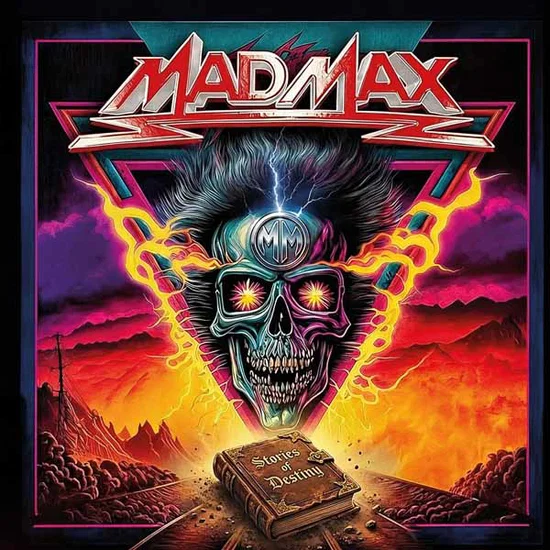
MAD MAX: Stories Of Destiny, 45 Years, A Box Of Old Cassettes And The Songs That Refused To Die
Interview by Paul Marshall
It’s another late night, another time zone, another conversation with a musician whose career stretches back further than some of the bands currently filling festival stages have been alive.
This time I’m talking to the fabulous Jürgen Breforth, rhythm guitarist, backing vocalist and chief raconteur for German melodic hard rock legends MAD MAX.
Jürgen appears on my screen with a soft German accent and an unmistakable warmth.
“Hi Paul, thanks for talking with me today.”
The pleasure, of course, is all mine.
There is an immediate humility about him. No rock-star swagger, no sense that 45 years of making music has somehow elevated him above everyone else. Instead, Jürgen tells me how much of an honour it is to be doing interviews in Australia and New Zealand.
“I’m so sorry to say this was never our market,” he admits. “But it’s one of my dreams that maybe one day we can come and play a couple of shows.”
And just like that, the conversation has already become personal.
Sadly, tonight’s conversation isn’t happening because MAD MAX are about to board a plane for New Zealand or Australia. We’re here to talk about Stories Of Destiny, the band’s upcoming studio album, due for release on September 4, a record that also happens to mark Jürgen’s 45th anniversary since founding the band in 1981.
But calling Stories Of Destiny simply a new album feels like missing the point.
This is part new record, part archaeological dig, part conversation between different versions of MAD MAX, and between the young Jürgen who was writing riffs in 1981 and the seasoned guitarist who is still writing, recording and playing them 45 years later.
“I founded the band, as you probably know, in 1981,” Jürgen tells me. “So this album is my 45th anniversary album.”
The title itself came from drummer Axel Kruse, who has been beside Jürgen in MAD MAX for an astonishing 40 years.
“Stories Of Destiny,” Jürgen says. “He came up with the title, and I think it pretty much nails it.”
It does.
Because Stories Of Destiny isn’t simply looking backwards. It is rummaging through the past and asking what those songs might sound like if they were given another life.
Take “Silver”, the album’s lead single.
Jürgen originally wrote the song in the early 2000s for Gary Barden, the legendary vocalist best known for his work with the Michael Schenker Group, and who had previously been a member of both Scorpions and UFO. Jürgen co-wrote the song with Andreas Broon, who had also played guitar with The Sisters of Mercy.
The plan was simple enough: write something big.
Jürgen believed “Silver” could become a genuine radio hit.
But the record business, as it so often does, had other ideas.
The label mishandled the release, there was no accompanying music video and the song disappeared without making the impact Jürgen believed it deserved.
Years later, he found himself looking back at it and thinking there was unfinished business.
“So I thought ‘Silver’ should be one of the songs I pick for this album.”
There is something wonderfully stubborn about that.
A song gets knocked down by the machinery of the music business, disappears for years, and eventually its writer simply decides: Not finished yet.
The same philosophy runs throughout Stories Of Destiny.
For many listeners, these songs will effectively be brand new.
“For 90% of the listeners these will be brand new songs,” Jürgen explains, “because they don’t know these old songs.”
Then there are the cassettes.
Actual cassettes.
Jürgen discovered original demos of “Till The End Of Time” and “Weapons Of Love” from 1991, recordings that had somehow survived three and a half decades.
I ask the obvious question: what condition were they in?
“That’s a good question,” he laughs.
The man he was working with in the studio attempted to transfer the recordings digitally. Eventually, they got a copy that was, in Jürgen’s words, “pretty OK to listen to.”
Pretty OK.
For a recording that has survived since 1991, that sounds like a minor miracle.
But hearing those riffs again brought something else back.
“The basic guitar riffs I had straight away,” Jürgen says.
The arrangement was another matter.
After all those years, he had to relearn how the songs actually went.
But that was precisely the point.
“I was really happy that I found those old songs because I really wanted to give the fans something really special.”
Then there is “Piece Of Candy”.
That title may sound like another song in a catalogue spanning 45 years, but its significance is far greater.
It contains the first guitar riff Jürgen ever wrote for MAD MAX.
And now, in 2026, he is recording it again.
“Isn’t that crazy!”
It really is.
“When I first founded the band I had a couple of guitar riffs, that was all,” he recalls. “And ‘Piece Of Candy’ was the very first guitar riff, and we still play it like I wrote it in 1981.”
There are few better ways of describing longevity in rock music than that.
Not reinventing the riff.
Not polishing away its history.
Just playing the damn thing.
Jürgen’s musical DNA has always been rooted in a particular kind of hard rock, early Def Leppard, Iron Maiden and Saxon.
But ask Jürgen what he learned from those formative bands and his answer is surprisingly simple.
“Less is more.”
Back in the early ’80s, he remembers, many German bands were singing in German.
His heroes were looking elsewhere.
Saxon. Maiden. Early Def Leppard.
And what those bands taught him wasn’t simply how to play guitar. It was a philosophy.
“Less is more.”
It’s a phrase that appears repeatedly during our conversation, and it seems to explain a great deal about Jürgen’s approach.
Even when we move from guitars to technology, the same instinct remains.
Jürgen has lived through virtually every major technological transformation in recorded music, analogue tape, vinyl, CDs, downloads, streaming and now artificial intelligence.
His verdict?
“Vinyl and analogue recording is heaven.”
CDs, he says, were OK.
Streaming is where the trouble starts.
“The situation today, especially for younger bands, is pretty hard, because the bands don’t make anything out of streaming. They can’t make a living anymore.”
Then comes AI.
Jürgen knows exactly where he stands.
“I know everyone is now talking about AI, so a lot of people don’t write their songs anymore.”
And then he gives me one of the best arguments for Stories Of Destiny.
“The coolest thing about the new album is that because the songs were written so early on in my career there was no AI, so everyone knows I am writing real songs.”
He pauses.
“So I have no problem with AI as everyone knows I am not using it.”
It is difficult to argue with the simplicity of that.
The songs on Stories Of Destiny carry fingerprints from another era, literally recorded onto old magnetic tape, written before streaming, before social media, before anyone had heard of ChatGPT.
They survived because somebody believed they were worth saving.
At this point I decide to take Jürgen somewhere slightly more ridiculous.
I ask him to imagine MAD MAX have been booked to play the world’s strangest festival, a festival where the entire audience consists of musicians he has admired throughout his life.
Who are the first three people he looks for?
He doesn’t hesitate.
“OK, the first would be Rory Gallagher, definitely. He’s my all-time hero.”
Number two?
“Malcolm Young.”
The reason is telling.
“He had the same philosophy as me, less is more.”
And number three?
“Steve Lee from Gotthard.”
Jürgen has met Lee several times, but the Gotthard singer died following a motorcycle accident in Nevada in 2010.
Three musicians. Three very different careers. But all of them connected by something that seems to matter deeply to Jürgen: authenticity.
Then I take him back to the beginning.
When did he first realise MAD MAX wasn’t simply a local German band anymore?
When did the possibility emerge that this could actually become his life?
The answer takes us to 1987 and the album Night Of Passion.
“That was the moment,” he says.
Suddenly, doors began opening.
Even the United States.
MAD MAX found themselves touring with Deep Purple, and the possibility of breaking into the American market seemed very real.
Then the record business got involved.
And, as has happened to countless artists before them, ambition collided with greed.
Jürgen explains that their label was attempting to sell several bands alongside MAD MAX to the American label. The problem was that the American company was interested in MAD MAX.
They wanted MAD MAX.
The additional sales pitch ultimately damaged the deal.
And because this was 1987, there were no mobile phones, no emails, no instant messages and no way for a band halfway around the world to understand what was happening behind closed doors.
“We had no idea of what was going on.”
The consequences were enormous.
The deal fell apart.
MAD MAX eventually split.
And Jürgen spent the next decade writing songs for other artists before bringing the band back together.
It is one of those moments in music history that makes you wonder how many careers might have taken completely different paths if the people making the business decisions had simply recognised what was standing directly in front of them.
But perhaps that is the real story behind Stories Of Destiny.
Destiny, after all, isn’t always a straight line.
Sometimes it is a cassette tape forgotten in a box.
Sometimes it is a song that a record company got wrong.
Sometimes it is a guitar riff written in 1981 that somehow survives 45 years.
Sometimes it is a band that breaks up, disappears for a decade, and then comes roaring back.
And sometimes it is a guitarist sitting in Germany in 2026, still talking about the same music he loved when he was a young man.
Jürgen Breforth has spent 45 years writing the story.
Stories Of Destiny is the latest chapter.
But perhaps the most remarkable thing about MAD MAX is that the story still doesn't feel finished.
If you’re an old-school rock fan, this album should already be on your radar.
If you’re discovering MAD MAX for the first time, even better.
Either way, mark September 4 in the diary.
Because after 45 years, Jürgen Breforth still has a few riffs left to play.